Licence Appeal Tribunal project hero image

A supportive Licence Appeal Tribunal experience

When people lose their driver's licence, they could lose their income, freedom, and way of life. Yet, the appeal process to regain their licence is unbelievably confusing and frustrating. Let's support our appellants.

Role
UX Designer
Timeline
8 months
Clients
Tribunals Ontario
Team
Andrea Gonzalez
Andrea Gonzalez
UX Designer
Gabrielle Woodside
Gabrielle Woodside
UX Designer

foreword

This case study is intentionally high-level and omits sensitive details. I would be happy to share deeper insights, research artifacts, and reflections in conversation.


scope

The engagement began with foundational scoping conversations to clarify purpose, constraints, and intended impact. While the initial brief focused on improving the website that provides information about appealing suspended driver’s licences, we approached the work from a broader service design lens. We developed a structured research plan that included internal stakeholder interviews, external interviews with appellants, usability testing of the website, and systems mapping to understand how the digital experience fit within the larger service ecosystem.


research

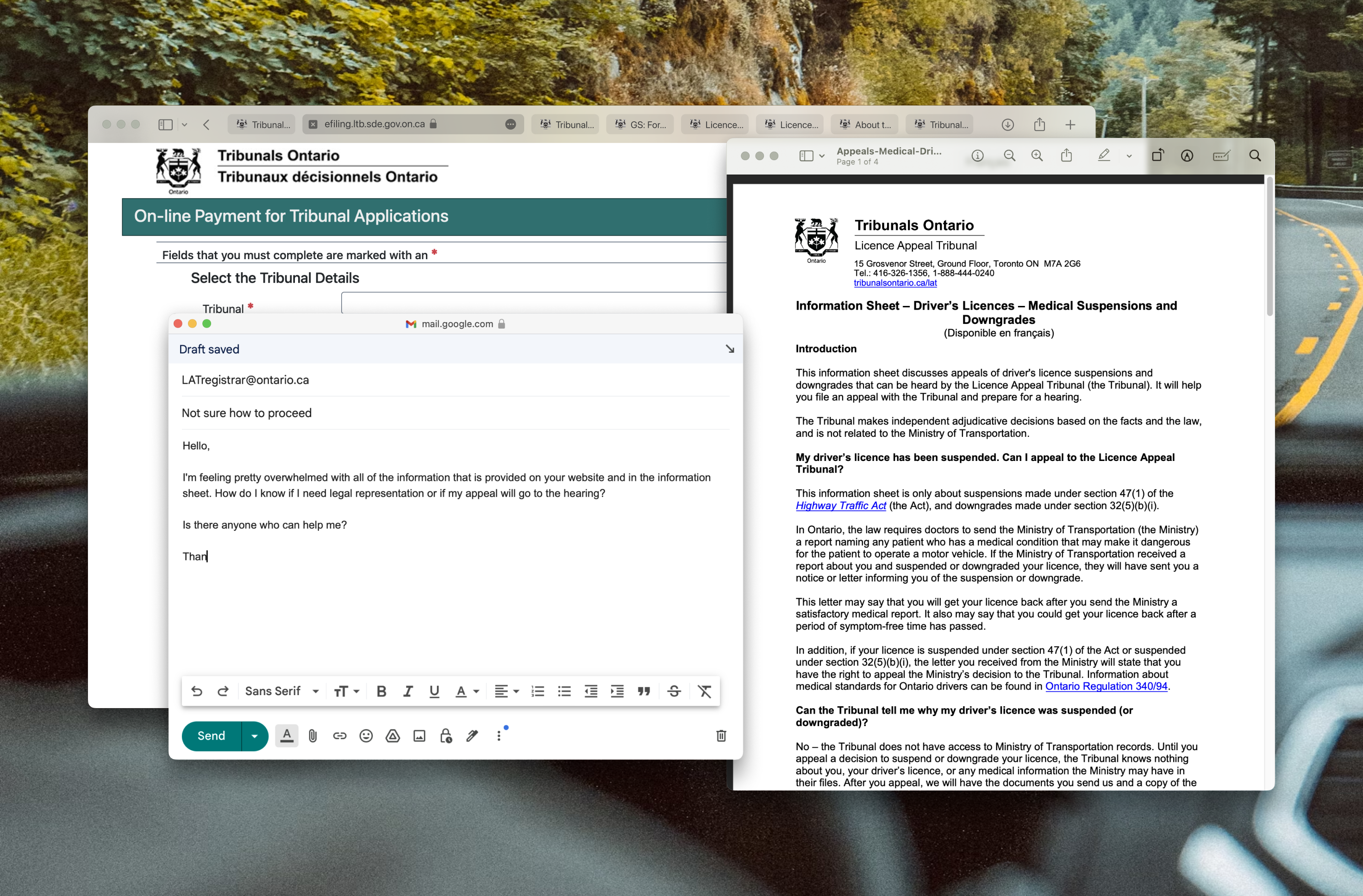
In total, we conducted 21 sessions with internal staff and external users, including past appellants, lawyers, case management officers, call centre staff, scheduling staff, and adjudicators. The sessions with past appellants were far more complex and emotionally charged than anticipated. Participants shared deeply personal stories involving medical crises, mental health challenges, substance use, and significant financial strain. It quickly became clear that the website was not their primary concern; many were navigating some of the most difficult periods of their lives. Recognising this, we adapted our approach in real time by incorporating trauma-informed practices, reassessing our facilitation methods, and broadening our analysis beyond usability. Through affinity mapping and systems analysis, we identified root causes such as confusion around process roles, inconsistent information, and critical gaps in financial, informational, and staff support. To further understand these dynamics, we created a service design blueprint that mapped internal staff workflows and touchpoints, revealing how operational processes directly shaped and sometimes constrained appellants’ experiences.

advocacy

To communicate these insights, we developed a persona matrix that illustrated four distinct appellant archetypes, highlighting their behaviours, attitudes, frustrations, and outcomes. We demonstrated how individuals entered the process as a “blank slate,” and how varying levels of support—financial, informational, and interpersonal—significantly shaped their trajectories. By surfacing inconsistencies in support and amplifying the lived experiences of appellants, we helped executives understand the emotional and financial pressures occurring beyond the formal appeal process, pressures that had largely been invisible at leadership levels. Our strategic recommendations focused on strengthening awareness and access to support, improving financial and informational resources, and enabling greater alignment across staff roles. The work reframed executive understanding of the service and drove meaningful improvements beyond the original website scope.


takeaways

With the initial focus on digital usability, I was taken aback when conducting the first website usability test, as my participant started yelling and swearing at me. I learned how critical it is to zoom out and examine the broader service context when users need it. The work reinforced for me that as UX designers, we are ultimately for the people. We have to hold space for vulnerable stories while maintaining clarity It also highlighted for me how easily leadership can become distanced from lived realities, and the power of narrative and stories to bridge that gap. Ultimately, this experience strengthened my ability to navigate complexity, apply trauma-informed practices in real time, and advocate for systemic change rather than surface-level fixes.